⚠️ Notice: research compound for laboratory use only. Not for human or veterinary consumption, diagnosis or treatment. Sold to adults 18+ only.
Where most compounds in metabolic research act on receptors from outside the cell (GLP-1, GIP), 5-amino-1MQ works inside it — as a small-molecule inhibitor of the enzyme NNMT, not a peptide. It was first characterised by a group at the University of Texas Health Science Center as pharmacological confirmation of an earlier genetic finding: mice lacking functional NNMT resist diet-induced obesity.
What NNMT does, and what happens when it is blocked
NNMT transfers a methyl group from S-adenosylmethionine (SAM) onto nicotinamide. That single reaction costs the cell two things at once: it diverts nicotinamide away from the NAD⁺ salvage pathway, and it spends SAM, the universal methyl donor for epigenetic modification. In the adipose tissue of obese individuals NNMT is overexpressed, which is what turned it into a watched target in metabolic research.
Inhibition reverses both flows — nicotinamide stays available for NAD⁺ regeneration (and therefore for the sirtuins SIRT1/SIRT3 and mitochondrial biogenesis), while SAM stays available for DNA and histone methylation.
What the preclinical work showed
- Neelakantan et al., 2018 (Biochemical Pharmacology) — obese C57BL/6 mice, 20 mg/kg s.c. three times daily for 11 days: significant loss of body weight and white adipose tissue mass with no change in food intake, alongside reduced plasma cholesterol and adipocyte size. Selectivity IC₅₀ = 1.2 μM against NNMT.
- Sampson et al., 2021 (Scientific Reports) — combined with a low-calorie diet, it reduced body weight, fat mass and hepatic steatosis more than either intervention on its own.
- Dimet-Wiley et al., 2024 (Scientific Reports) — in aged mice, NNMT inhibition reproduced part of the exercise response: 5-amino-1MQ alone gave a 40% improvement in grip strength, and 60% combined with exercise, suggesting a mechanism distinct from training itself.
Important: none of this work was carried out in humans. As of July 2026 no human clinical studies have been published, and translation of these findings to human biology is unconfirmed.
Specifications
| Name | 5-amino-1-methylquinolinium |
| Type | Small-molecule NNMT inhibitor (not a peptide) |
| IC₅₀ against NNMT | 1.2 μM |
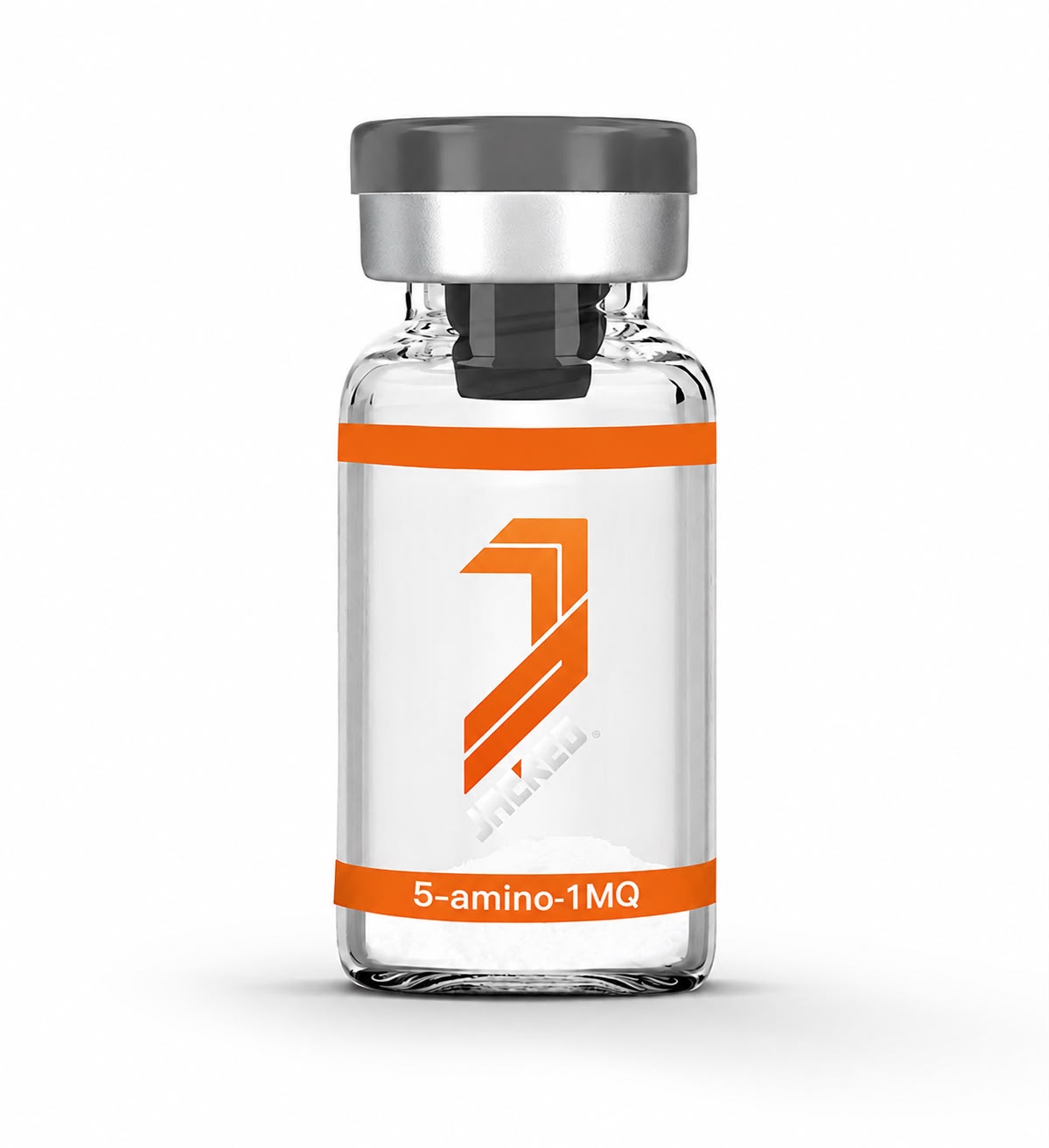
| Content | 50 mg / vial |
| Form | Lyophilised powder |
| Purity | ≥ 98% (HPLC) |
| Intended use | Preclinical and laboratory research, 18+ |
Storage and reconstitution
Keep the lyophilisate at −20 °C, protected from light. Prepare the stock solution in DMSO, then dilute into aqueous buffer (PBS). Aliquot reconstituted material and store at −20 °C — avoid repeated freeze-thaw cycles.
5-amino-1MQ in this form is not approved by any regulatory body (FDA, EMA, ŠÚKL) for human use. It is not a medicine or a food supplement. The seller accepts no liability for use contrary to these terms.